Is a Home X-ray as Accurate as One at the Hospital?
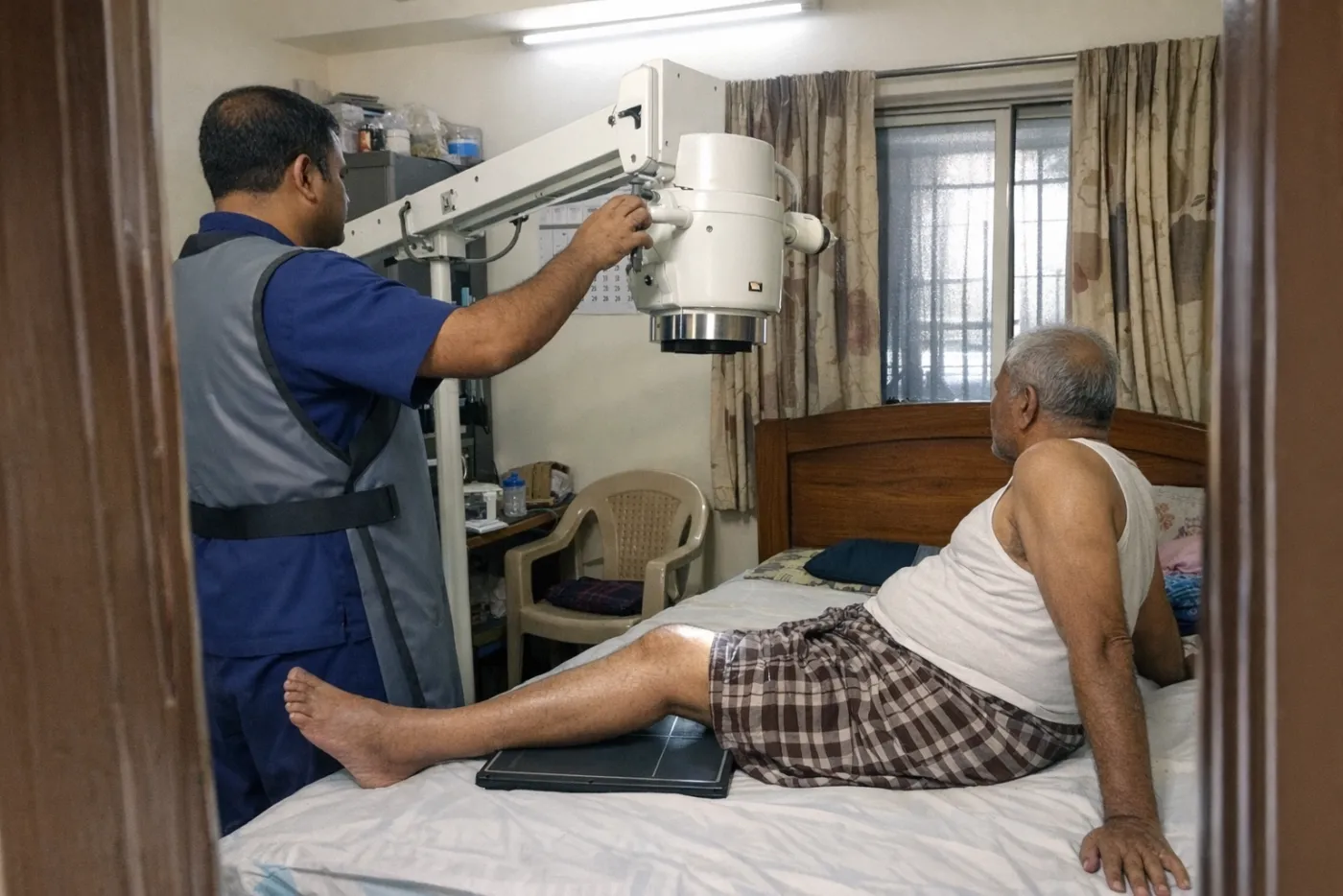
If you've ever tried to get a parent with a bad hip into a car, through a hospital lobby and onto an X-ray table, you'll understand why home X-rays exist. The question most families ask next is a fair one. If the machine comes to the bedroom, is the picture as good?
For most X-rays doctors ask for, the short answer is yes. Portable machines are the same kind of equipment hospitals wheel to the bedside in ICUs and wards every day, for patients too unwell to move. But there are a few X-rays where a fixed hospital machine does better, and it helps to know which ones before you book.
What actually decides how good an X-ray is
An X-ray image comes down to four things. The machine has to put out enough power for the part of the body being imaged. The detector behind the patient has to capture the image cleanly. The patient has to be positioned correctly and kept still. And someone qualified has to read it.
Modern portable units use the same kind of digital detector plates that hospital rooms use, so the second point is largely a wash. The images come out as digital files that a radiologist reads on a proper screen, the same way they would read a hospital film.
Where home and hospital can differ is power and positioning. That's what decides which X-rays travel well.
Where a home X-ray is just as good
Chest X-rays are the most common bedside X-ray in the world. ICUs rely on them to check lungs, tubes and lines, sometimes daily. For pneumonia, fluid on the lungs, or a doctor wanting to see how the lungs look after a cough that won't settle, a home chest X-ray does the job.
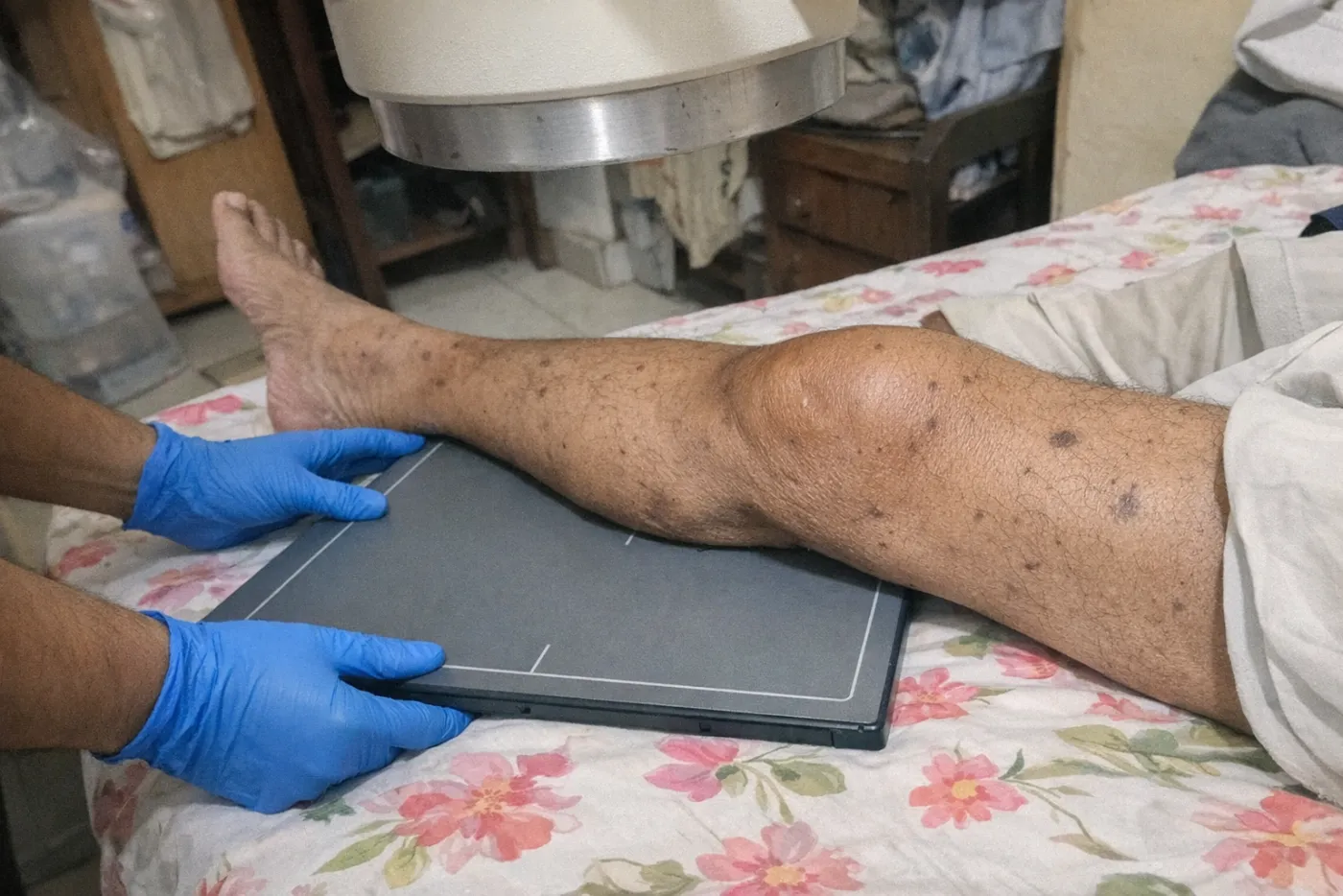
Arms and legs are also well suited to it: hands, wrists, elbows, shoulders, knees, ankles and feet. These are thin parts of the body that don't need much power, and they're easy to position on a bed. Most knee X-rays for arthritis, and most checks for a possible fracture after a fall, fit here.
The hip and pelvis usually work well too, with a front view taken while the patient lies on their own bed. For an older parent after a fall, that can be the difference between getting an answer today and waiting until someone can arrange the trip.
Where the hospital still has an edge
Thicker parts of the body need more power. A side view of the lower back is the classic example, particularly in a larger adult. Portable machines have less output than a fixed hospital unit, so the technician may need a longer exposure, and any movement during it shows up as blur. A good technician will tell you if the image isn't good enough, but it's worth knowing that lower-back side views are the ones most likely to need a repeat.
Standing (weight-bearing) views are another. Doctors sometimes ask for knee X-rays taken standing because the gap in the joint narrows under body weight, which shows arthritis more honestly. That's possible at home if the patient can stand for a few seconds with support. If they can't, the X-ray will be taken lying down and the doctor should know that.
Some studies simply can't be done at home. Anything with contrast dye, live X-ray (fluoroscopy), CT and MRI all need hospital equipment. If the prescription mentions one of these, a home service should tell you straight away.
The chest X-ray difference worth knowing about
There's one quirk that confuses families when they compare reports. At a hospital, a chest X-ray is usually taken standing, with the patient's chest against the plate and the beam coming from behind. That's called a PA view. At home, with the patient sitting up in bed, it's taken the other way round, as an AP view.
On an AP view the heart sits further from the plate, so it looks a bit bigger. A heart that's normal can look borderline enlarged. Radiologists know this and allow for it, which is why the report should say which view was taken. If your parent's doctor is comparing a new home X-ray with an old hospital one, mention that the new one was taken sitting up in bed. It saves a lot of unnecessary worry.
How to get the most reliable result
Tell the booking team exactly what the prescription says, or send a photo of it. If you're not sure how to read it, our X-ray prescription decoder turns shorthand like "LS spine AP/Lat" into plain English.
Have older X-rays handy. A radiologist comparing today's image with one from two years ago can say far more than one reading an image in isolation.
Make the room easy to work in. Clear a little space around the bed, and help the patient into whatever position the technician asks for. A few seconds of stillness matters more than anything else.
Ask for the images, not just the report. A photo of the film on a phone screen loses detail. The digital images are what another doctor will want if they need a second look.
And if something about the image or report seems off, say so. Repeating one view is quicker than a hospital trip, and a good provider would rather redo it than send a report they're unsure of.
Where we come in
If your parents live in Bangalore, we offer an X-ray at home with a portable machine, a trained technician and a radiologist's report on WhatsApp. It's ₹500 for the visit plus ₹200 per view. We'll also tell you on the call if your X-ray is one of the few that's better done at a hospital.
Questions that come up a lot
Is a portable X-ray as good as a hospital X-ray?
For chest, limb, hip and most joint X-rays, yes. Hospitals use the same kind of portable machines at the bedside every day. Fixed hospital machines have more power, which helps with thicker areas like side views of the lower back, especially in larger adults.
Why does my parent's heart look bigger on the home X-ray?
Home chest X-rays are usually taken from the front (AP) while sitting up in bed, which makes the heart look larger than on a standing hospital (PA) view. Radiologists allow for this. Tell the doctor which view each X-ray was if they're comparing two.
Who reads a home X-ray?
A radiologist, the same kind of specialist who reads hospital X-rays. The images are digital, so they're read on a proper screen and the report comes back to you.
Which X-rays can't be done at home?
Anything that needs contrast dye, live X-ray (fluoroscopy), CT or MRI. Lateral lower-back views in larger adults are possible but more likely to need a repeat.
Can a home X-ray be used for a fracture?
Yes. Checking for a fracture after a fall, in a wrist, ankle, hip or shoulder, is one of the most common reasons for a home X-ray. If the patient is in severe pain, can't move the limb, or the limb looks out of shape, go to a hospital instead. They may need treatment, not just a picture.
Seri shares general guidance and isn't a substitute for a doctor or radiologist. For a fall with severe pain, a head injury, or any sudden change in how someone seems, go to a hospital or call 108.