Is an X-ray at Home Safe? Radiation, Explained for Families
The first time someone books an X-ray at home, the question usually isn't about the patient. It's about everyone else. The grandchild asleep in the next room. The daughter-in-law who's pregnant. The house help who's been with the family for twenty years and will be in the kitchen when the technician arrives.
That's a sensible thing to worry about, and the answer is reassuring, as long as a few simple rules are followed. Here's what the numbers actually look like, and what you should expect the technician to do.
How much radiation is in an X-ray
Everyone on earth gets a steady, low dose of radiation from the ground, the air and even food. Worldwide it averages about 2.4 millisieverts (mSv) a year. It's the easiest way to put any X-ray in perspective.
A chest X-ray is somewhere around 0.02 to 0.1 mSv, depending on the machine and which estimate you use. That's a few days to about ten days of the radiation you'd get anyway. It's roughly what you pick up on a long-haul flight.
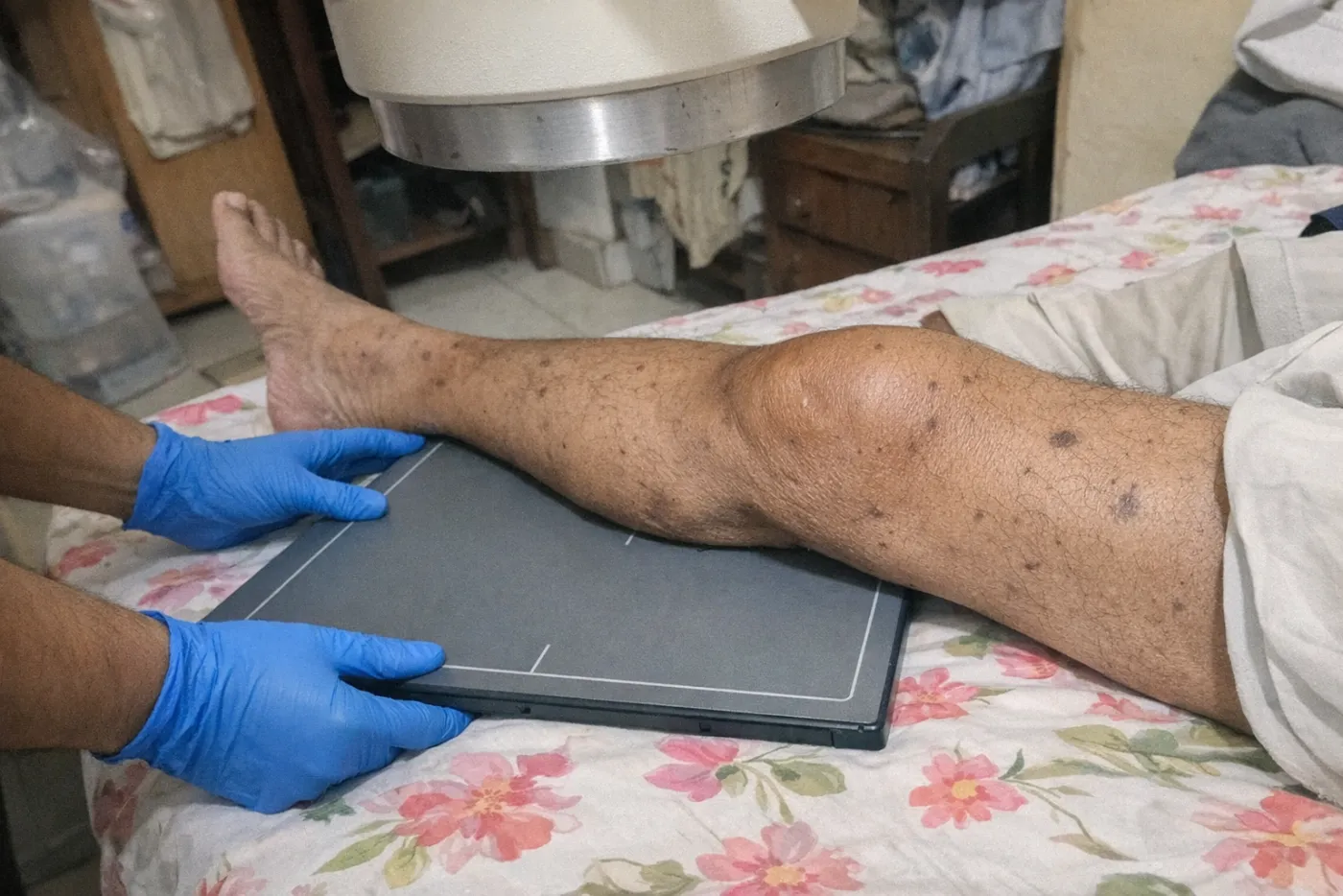
An X-ray of a hand, knee, ankle or foot is much smaller, around 0.001 mSv. That's less than a day of natural background.
A lower-back X-ray is the bigger one, closer to 1 mSv or a little more, because the beam has to pass through more of the body. That's a few months of background. It's still a low dose, and it's why doctors ask for spine X-rays when they're genuinely needed rather than routinely.
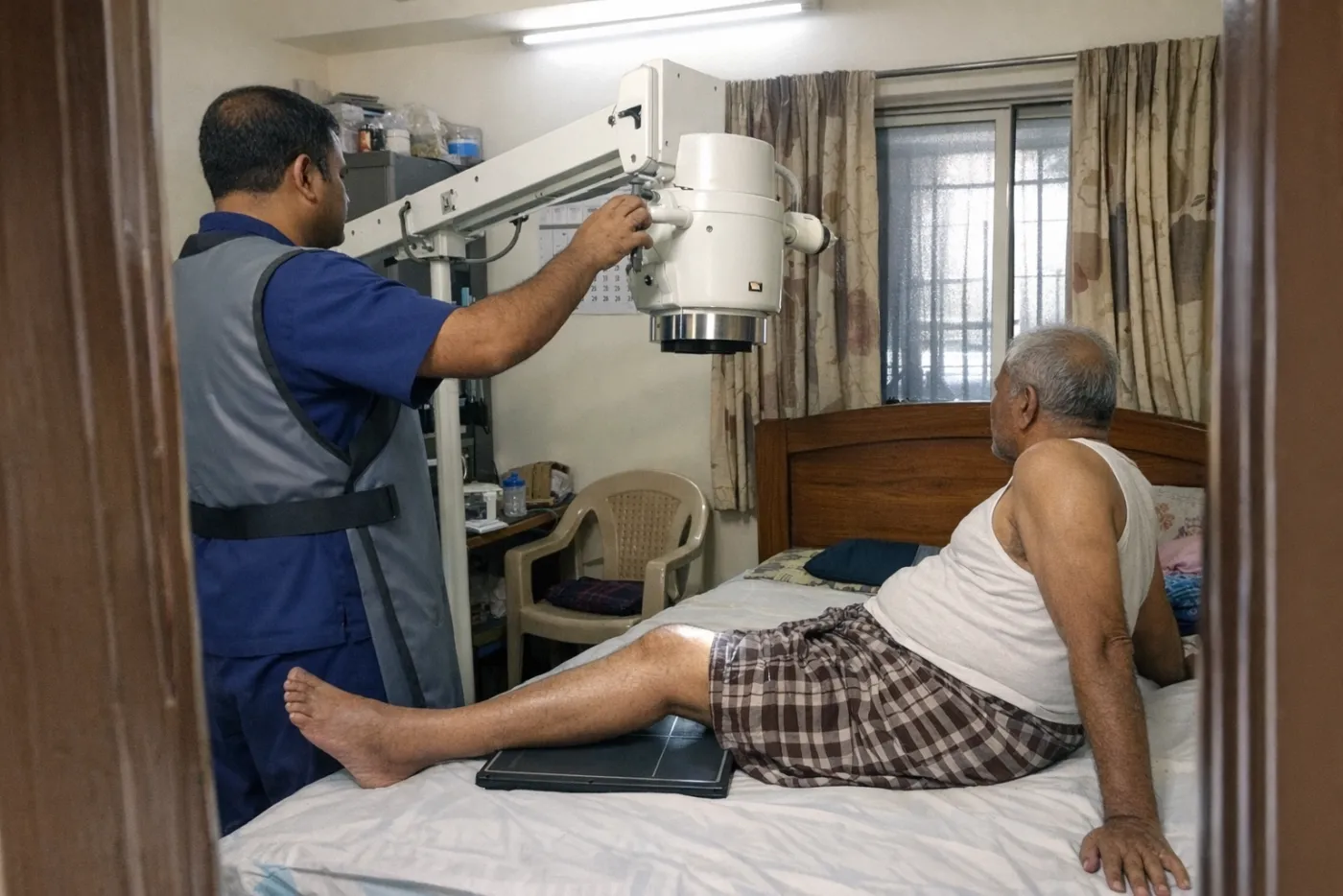
These numbers are the same at home and at a hospital. The patient gets a similar dose either way. Portable machines don't give more radiation. If anything, they tend to run at lower power.
What it means for everyone else in the house
An X-ray beam is narrow and only on for a fraction of a second. It's pointed at the patient and the detector plate behind them. The thing to think about is scatter: a small amount of radiation bounces off the patient's body in other directions.
Scatter falls away very quickly with distance. Every time you double the distance, the dose drops to a quarter. A couple of metres away it's tiny. In the next room, behind a wall, it's negligible.
So the rule is simple. While the image is being taken, only the patient should be in the room, or anyone who has to hold the patient still, standing well back and wearing a lead apron if the technician offers one. Everyone else steps outside for the few seconds it takes. The technician should ask for this. If they don't, it's fine to ask them.
Pets, children and anyone pregnant should be out of the room, not just standing back.
When to speak up first
Tell the technician before they start if the patient might be pregnant. For an X-ray of the chest or a limb, the dose that reaches a pregnancy is extremely small. For the abdomen, pelvis or lower back, it's worth a conversation with the doctor about whether it can wait or whether another test would do. The doctor makes that call, not the technician.
Mention it if the patient has had several X-rays recently. Doses add up over time, though for chest and limb X-rays they add up very slowly. Keeping old X-rays and reports means a doctor can sometimes compare instead of repeating, which is the easiest way to avoid unnecessary ones.
And tell them if the patient can't keep still, because of pain, confusion or a tremor. Movement blurs the image, and a blurred image is the main reason an X-ray has to be repeated.
Lead aprons and covers
You might expect the patient to be draped in a lead cover. Sometimes they will be, sometimes not. Many radiology bodies now advise against routinely shielding patients, because a cover in the wrong place can block the very thing the doctor needs to see and lead to a repeat X-ray, which means more radiation rather than less. The technician will wear an apron because they do this many times a day. For the patient, getting it right first time is what keeps the dose low.
Is the machine itself safe?
In India, medical X-ray machines, portable ones included, have to be approved and registered with the Atomic Energy Regulatory Board (AERB). The people operating them should be trained radiographers or X-ray technicians. It's completely reasonable to ask a home X-ray provider whether their machine is AERB registered and what training their technicians have. A good provider will answer without fuss.
Where we come in
If your family is in Bangalore, we offer an X-ray at home. The technician brings a portable machine, asks everyone except the patient to step out for the exposure, and the radiologist's report comes to you on WhatsApp. If you're also wondering whether the image will be as good as a hospital's, we've written about home X-ray accuracy separately.
Questions that come up a lot
Is it safe to have an X-ray done at home?
Yes, when it's done properly. The patient gets about the same small dose as at a hospital, and family members are protected by stepping out of the room for the few seconds the image takes.
Can I stay in the room during a home X-ray?
Only if you need to hold the patient still, and then you should stand back and wear a lead apron if one is offered. Everyone else, and especially children and anyone pregnant, should wait outside the room.
How much radiation is a chest X-ray?
Roughly 0.02 to 0.1 mSv, which is a few days to about ten days of the natural background radiation everyone gets. It's in the same range as a long-haul flight.
Does radiation stay in the room after an X-ray?
No. The machine only produces X-rays while it's firing, for a fraction of a second. Nothing lingers in the room, the bed or the patient afterwards.
Can a pregnant woman be in the house during a home X-ray?
Yes. She should be out of the room while the image is taken, which is enough. If the patient herself is or might be pregnant, tell the technician and the doctor before the X-ray.
Seri shares general guidance and isn't a substitute for a doctor or radiologist. If you're unsure whether an X-ray is right for someone who is pregnant or has had many recent scans, ask the doctor who prescribed it.